
November 17, 2026
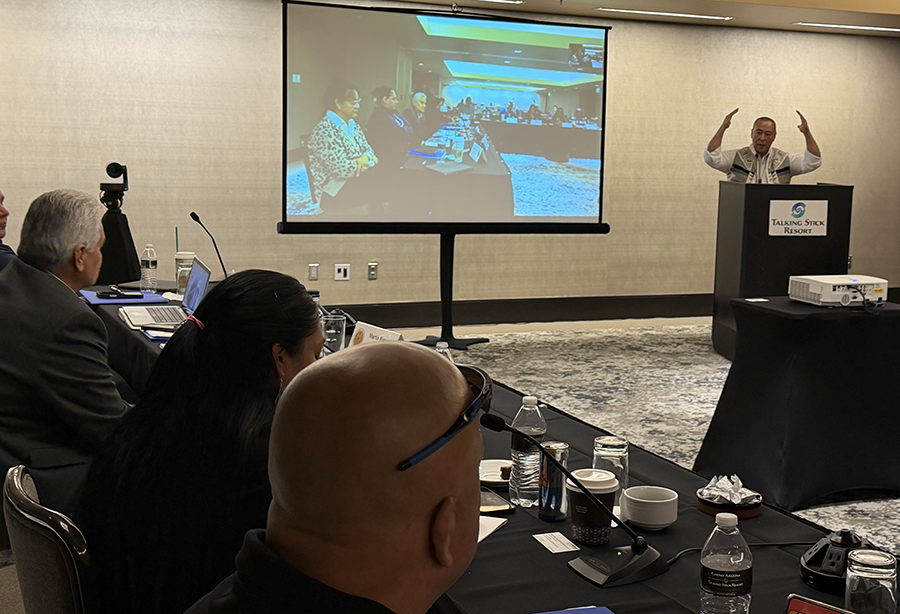
SCOTTSDALE, AZ. – November 13, 2026 – Indian Gaming Association (IGA) continues its outreach across Indian Country to bring Tribal priorities to the forefront of federal advocacy. Under Chairman David Z. Bean, that work focuses on defending Tribal government gaming, strengthening member communication, broadening partnerships, and creating new opportunities for Tribal economic diversification.
On November 13, 2026, IGA presented to the Inter-Tribal Association of Arizona (ITAA) in Scottsdale, Arizona; Chairman Bean outlined those priorities and provided updates on the legislative and election landscape. The visit reflected IGA’s commitment to meeting directly with Tribal governments and carrying their guidance into its work in Washington.
Established in 1952, ITAA brings together 21 Arizona Tribes to provide a united voice on issues of common concern and a means for collective action on matters affecting Tribal governments individually or together. Working with organizations such as ITAA helps IGA remain connected to regional priorities and carry Tribal leaders’ guidance into its national advocacy.
“Quite simply put, we are your boots on the ground in Washington, D.C., for all things Indian gaming,” Bean said.
Tribal government gaming generated $46.2 billion in gross gaming revenue in fiscal year 2025, an increase of $2.3 billion, or 5.3 percent, over the previous year, according to the National Indian Gaming Commission. That economic strength supports Tribal governments, essential services, and community investment. Protecting it is central to IGA’s advocacy and its commitment to building an organization equipped to serve Indian Country.
Bean reported that IGA has 125 member Tribes and identified expanding participation as a priority. The association is reaching current, former, and prospective members through more state and regional Tribal meetings, replacing its mid-year gathering with outreach that brings IGA closer to the governments it serves. Tribal leaders’ guidance shapes that work, from federal policy priorities to member services.
“And so that’s my goal, to, through partnership, grow the association and lift up Indian country in the process,” Bean said.
IGA’s fight against illegal online gambling remains a leading priority, including its opposition to sports betting offered through prediction markets outside Tribal and state gaming regulation. IGA maintains that presenting wagers as financial event contracts does not override Tribal regulatory authority, Tribal-state compacts, or the protections of the Indian Gaming Regulatory Act.
Working alongside Tribal Nations and partner organizations, IGA is pursuing congressional oversight, legislative protections, litigation support, and public education. Bean outlined plans to seek oversight hearings through the congressional committees responsible for the Commodity Futures Trading Commission. He also recognized Arizona Tribal Nations for bringing Tribal arguments before the courts through amicus briefs.
IGA’s partnership with the National Congress of American Indians further strengthens coordination among Tribal Nations on these legal, legislative, and regulatory challenges. The work brings Tribal priorities into national policy discussions while respecting each Nation’s authority to chart its own course.
An IGA-commissioned study by KlasRobinson Q.E.D. illustrates the potential economic stakes. Its scenarios project approximately $1.5 billion in annual Tribal gaming revenue losses if sports event contracts operate nationwide outside Tribal and state gaming regulation. Under a broader scenario that assumes expansion into online casino-style gaming and major operators shifting to prediction market platforms, projected Tribal gaming losses exceed $7.8 billion annually. These are conditional projections, not losses already recorded or inevitable outcomes.
“For our nations, lost revenue means less funding for health care, education, housing, and valuable, vital services that our communities rely on,” Bean said.
IGA’s legislative work also extends to protecting meaningful government-to-government consultation, sacred sites, and Tribal homelands. Bean discussed opposition to provisions of the Bipartisan American Affordability and Jobs Act (BAAJA) that he warned would weaken Tribal participation in federal decisions. He emphasized responsible development that respects Tribal governments and their role in decisions affecting their lands and people.
The election results and the incoming Congress bring renewed urgency to IGA’s commitment to educating lawmakers about Tribal sovereignty and the role of Tribal government gaming. Bean recognized the strength of the Native vote and the opportunity to build relationships with newly elected officials while strengthening engagement with returning members. Working alongside Tribal leaders and guided by their priorities, IGA will carry that work into the new Congress.
That commitment means helping members of Congress and their staff understand Tribal Nations as sovereign governments, the services funded by gaming revenues, and the consequences of federal decisions for Tribal communities. IGA’s outreach will connect those responsibilities to the work ahead on prediction markets, Tribal regulatory authority, meaningful consultation, and economic self-determination. Election results open the door to new conversations; sustained education and advocacy are how IGA will work with Tribal leaders to turn those conversations into informed policy.
Building the association also means broadening economic opportunities. Bean outlined plans to expand the 2027 trade show floor and develop partnerships in agriculture, energy, and other industries that can support Tribal diversification. He identified work with the Intertribal Agriculture Council, Intertribal Buffalo Council, and the National Center, along with developing a partnership with the Indigenous Cannabis Industry Association for Tribes interested in that sector.
These relationships can connect Tribal producers, suppliers, and enterprises with the purchasing power and business opportunities of Indian gaming. They also create avenues for participation by Tribal Nations that do not operate gaming facilities, while broadening opportunities for Tribal and associate members to build business relationships.
“We want to lift up all tribal enterprises that will support the gaming industry,” Bean said. “Not every tribe is involved in gaming, but they’re involved in an industry or provide a product or service that could support the gaming industry.”
Bean also announced upgrades to member communications on IGA365, its membership portal, to simplify membership registration and keep contact information current as Tribal leadership changes. Together with direct outreach, these improvements help IGA respond to member needs and keep Tribal governments connected to legislative alerts, association updates, and opportunities to participate.
“We are responding to make sure we expand our communication, expand our reach,” Bean said.
IGA’s commitment is to continue to build the organization through service to its members: listening to Tribal leaders, working alongside them, and carrying their priorities forward in Washington and across Indian Country.
“We did not get here alone, and we’re not going to move forward alone,” Bean said.
Nov / 2026
IGA Prioritizes Expanding Outreach and Partnerships Across Indian Country to Protect Sovereignty and Grow Membership
Nov / 2026
Chairman David Z. Bean Highlights IGA’s Commitment to Expanding Partnerships and Tribal Economic Opportunity at Indigenous Cannabis Summit
Nov / 2026